
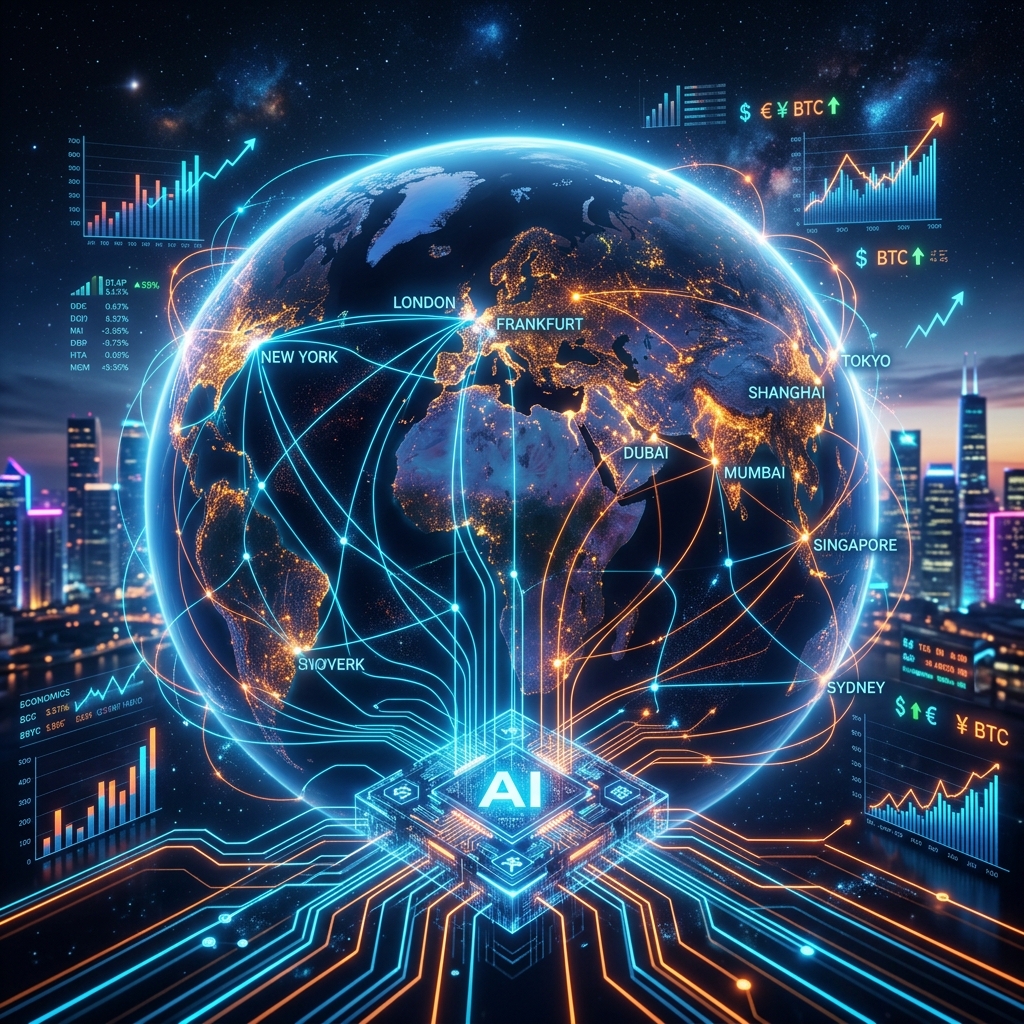
If the early 2020s were characterized by the initial explosion of generative AI into the public consciousness, 2026 will be recorded in economic history as the year Artificial Intelligence fundamentally rewired the global economy. We are no longer talking about chatbots writing emails; we are witnessing profound structural shifts in labor markets, capital allocation, global supply chains, and inflation dynamics.
In this mid-year Global Markets Update, we dive deep into the macroeconomic indicators to understand exactly how the AI revolution is impacting traditional economic models. For investors, professionals, and policymakers alike, understanding these tectonic shifts is no longer optional—it is critical for survival and prosperity in the new economic paradigm.
The Great Productivity Boom
For decades, economists puzzled over the "productivity paradox"—the observation that despite massive advancements in computing and the internet, measured productivity growth remained sluggish across the developed world. In 2026, that paradox has finally been shattered.
Recent data from the Bureau of Economic Analysis (BEA) indicates a stunning spike in non-farm labor productivity. AI tools are now deeply integrated into enterprise workflows. Legal research that previously took paralegals dozens of hours is now executed flawlessly in seconds. Software development cycles have compressed dramatically due to AI coding assistants. Logistics networks are optimizing routing in real-time with predictive AI, cutting fuel costs and delivery times.
This productivity boom is the primary driver keeping the global economy afloat amidst high interest rates. Companies are doing significantly more with fewer resources, leading to expanded profit margins for the S&P 500, particularly within the tech, healthcare, and financial sectors.
Labor Market Disruption: The "Hollow Middle"
The impact on the labor market has been swift and brutal in some sectors, while creating unprecedented demand in others. Economists are calling this the "Hollow Middle" effect.
Traditional mid-level, knowledge-based roles—such as junior analysts, administrative managers, and mid-tier content creators—are facing severe contraction. Corporations are realizing that a senior expert armed with advanced AI tools can output the work of a team of five junior employees.
However, this hasn't led to the mass unemployment dystopian scenarios predicted a few years ago. Instead, we are seeing a massive reallocation of labor. Two ends of the spectrum are booming:
- High-Level Strategic and Creative Roles: Humans who can direct AI, formulate complex strategies, and provide high-level emotional intelligence and leadership are commanding premium salaries.
- Skilled Physical Trades: Plumbers, electricians, HVAC technicians, and specialized manufacturing roles are seeing record wage growth. AI cannot fix a leaky pipe or install a solar array (yet). The physical economy remains resolutely human-driven, and a shortage of skilled tradespeople has created a lucrative market for these professionals.
The CaPex Arms Race and Energy Markets
The deployment of AI at a global scale requires an infrastructure build-out unseen since the early days of the internet. The Capital Expenditure (CapEx) from mega-cap tech companies (often referred to as the "Magnificent Seven") into AI data centers, specialized silicon (GPUs and NPUs), and networking infrastructure is staggering, currently running into the hundreds of billions of dollars annually.
This CapEx boom has created a massive ripple effect across the global economy, most notably in the energy sector. AI data centers are incredibly power-hungry. The computational intensity of training and running advanced models has surged global electricity demand.
Consequently, we are seeing a renaissance in both renewable energy investments and traditional base-load power sources. Uranium prices and nuclear energy stocks have hit multi-decade highs as tech giants seek reliable, carbon-free power to fuel their AI ambitions. The intersection of AI and energy is emerging as one of the most critical investment themes of the late 2020s.
The Inflation vs. Deflation Tug-of-War
Central banks around the world are facing a complex new reality. AI introduces a massive deflationary force into the economy. By dramatically lowering the cost of producing goods and, increasingly, services, AI acts as a downward pressure on prices. If software can provide financial advising, legal counsel, or medical diagnostics at a fraction of the historical cost, overall inflation should theoretically plummet.
However, this deflationary force is currently locked in a tug-of-war with several inflationary pressures:
- Resource Scarcity: The aforementioned demand for energy, copper, and rare earth metals needed for AI infrastructure is driving up commodity prices.
- Deglobalization: Geopolitical tensions and the desire for sovereign AI capabilities are forcing countries to on-shore semiconductor manufacturing and secure domestic supply chains, which is inherently more expensive than the hyper-globalized model of the 2010s.
- Wage Pressures in Trades: As mentioned, the severe shortage of skilled physical labor is keeping wage inflation high in certain sectors.
The resulting economic environment is highly bifurcated. We are seeing sharp price declines in digital goods and knowledge services, offset by rising costs for physical goods, energy, and housing. Central banks are struggling to calibrate monetary policy using traditional metrics that may no longer accurately capture this dual-speed economy.
The Rise of Sovereign AI and Geopolitics
In 2026, AI is no longer just a corporate asset; it is a matter of national security. The concept of "Sovereign AI" has taken hold globally. Nations recognize that relying entirely on foreign-developed foundation models poses a severe strategic risk to their cultural independence, economic security, and military capabilities.
We are witnessing an unprecedented wave of government-backed investment into localized AI ecosystems. European nations, Middle Eastern sovereign wealth funds, and Asian economic powerhouses are heavily subsidizing domestic AI research, building national supercomputers, and aggressively stockpiling silicon.
This geopolitical scramble is accelerating the fragmentation of the global tech ecosystem. The idea of a single, unified global internet and shared technological standard is fracturing into regional blocs, heavily influencing international trade agreements and capital flows.
Looking Ahead: Adapting Your Portfolio
For individual investors, navigating the AI-driven economy of 2026 requires agility and a willingness to discard outdated models. The traditional 60/40 (stocks/bonds) portfolio is being stress-tested by these new macroeconomic realities.
To thrive in this environment, investors should consider a barbell approach:
- Embrace the Innovators: Maintain exposure to the companies driving the AI revolution, but be discerning. The initial "hype phase" is over. The market is now ruthlessly demanding actual ROI and revenue growth from AI investments, not just promises.
- Invest in the Hard Assets: Balance your digital exposure with hard assets that cannot be replicated by code. Real estate, commodities, energy infrastructure, and companies providing essential physical services offer a crucial hedge against digital disruption.
The global economy is undergoing a metamorphosis. Those who recognize the structural shifts driven by AI—rather than dismissing it as a mere technological trend—will be positioned to capture generational wealth in the years to come.
Frequently Asked Questions (FAQ)
How will AI impact the developing world?
The impact of AI on developing economies is complex. On one hand, AI offers the opportunity to "leapfrog" legacy infrastructure, particularly in healthcare diagnostics and educational technology. A mobile phone with internet access can now deliver world-class medical advice and personalized tutoring to remote areas. On the other hand, the automation of call centers, low-level coding, and basic administrative tasks threatens the Business Process Outsourcing (BPO) industries that many developing nations rely on for economic growth. The key for these nations will be pivoting from providing low-cost manual digital labor to managing and maintaining AI systems.
Will AI eventually write all software?
AI is already writing a significant portion of boilerplate code and accelerating the development process for senior engineers. However, the role of the software engineer is evolving rather than disappearing. Instead of manually typing out syntax, developers are becoming "system architects" and "prompt engineers," focusing on the high-level logic, security architecture, and business requirements while delegating the actual coding to AI agents. The demand for abstract problem-solving skills in technology has never been higher.
What happens to the global energy grid?
The energy demands of AI are forcing a massive reckoning in global energy markets. A single AI query uses significantly more electricity than a traditional Google search. As a result, tech giants are directly funding the revival of nuclear power (including Small Modular Reactors) and massive renewable energy projects. We are entering an era where access to cheap, abundant, and clean energy is the primary bottleneck for technological supremacy, fundamentally altering geopolitical power dynamics.
Disclaimer: This article is for informational and educational purposes only and should not be construed as financial or investment advice. Always consult with a registered financial advisor before making any investment decisions.