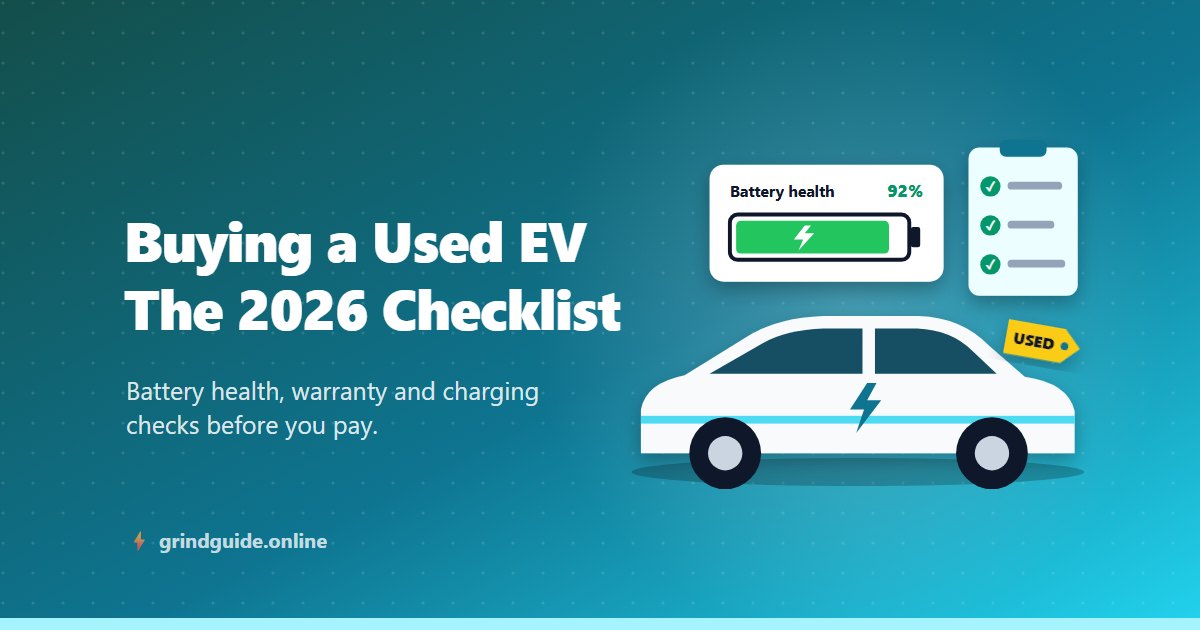
The used electric car market has grown up fast. With new-EV sales slowing after the federal tax credit ended, a wave of three to five year old EVs coming off lease, and running costs far below a gas car's, more buyers than ever are shopping for a second-hand EV. Some industry reports now show used EVs selling faster than comparable gas cars.
But a used EV is not a used gas car with a different engine. The most valuable component, the battery, is invisible on a test drive, and charging compatibility, software support, and warranty status matter in ways they never did for petrol cars. This checklist walks you through everything to check before you hand over your money.
The five checks that matter most
1. Get a battery state-of-health report.
2. Confirm the remaining battery warranty and that it transfers.
3. Check the charging port and fast-charging access for where you drive.
4. Run the VIN for open recalls and title problems.
5. Make sure the car's real-world range covers your life, with room to spare in winter.
1. Is a Used EV a Good Deal in 2026?
For many buyers, yes. EVs lose value faster than gas cars in their first few years, which hurts the first owner but helps the second. According to Cox Automotive, the average used EV listed for about $34,800 in early 2026, within roughly $1,300 of the average used gas vehicle. As recently as early 2023, that gap was more than $10,000. Prices rose through the summer as demand picked up, but used EVs remain far better value than they were a few years ago.
The other half of the equation is running costs. Charging at home is typically much cheaper per mile than buying gasoline, and EVs need less routine maintenance, with no oil changes, spark plugs, or exhaust systems. Our 5-year EV vs gas cost breakdown runs the full numbers.
One thing that has changed: the federal used EV tax credit is gone. The credit of up to $4,000 ended for vehicles acquired after September 30, 2025. Some states and utilities still offer rebates, so check what is available where you live.
2. Battery Health: The Single Most Important Check
The battery is the most expensive part of an EV, and its condition decides how far the car will go and what it is worth. Every lithium-ion battery loses capacity gradually. The question is whether this one has lost a normal amount.
What is normal?
Real-world fleet data from Geotab's 2026 study of more than 22,700 vehicles puts the average degradation rate at about 2.3 percent per year. Cars that were rarely fast-charged averaged closer to 1.5 percent, while heavy fast-charging pushed it to around 3 percent. That gives you a rough benchmark:
| Vehicle age | Typical battery health | Worth questioning if below |
|---|---|---|
| 2–3 years | 93–97% | 90% |
| 4–5 years | 89–94% | 85% |
| 6–8 years | 83–90% | 80% |
| 9–10 years | 79–86% | 75% |
Rough guide based on average fleet degradation rates. Most packs lose capacity faster in the first year or two, then level off. Older models with passive air cooling can degrade faster, especially in hot climates.
For the full picture of how and why batteries age, see our deep dive on EV battery life and degradation.
How to get a battery health reading
- Ask for a state-of-health (SoH) report. Many franchised dealers can run a diagnostic, and some manufacturers show battery health in their apps. Reputable used-EV dealers increasingly include a battery report with every car.
- Use an independent battery report. Services such as Recurrent offer battery and range reports on many popular models, based on the car's data and comparisons with similar vehicles.
- Use a model-specific scanner app. For some cars, an inexpensive OBD-II Bluetooth dongle and an app give a direct reading. LeafSpy for the Nissan Leaf is the best-known example.
- Tesla's built-in test. Some Tesla models offer a battery health test through the service menu, though availability varies by model and software version. If it is not available, ask for a report from Tesla or an independent service instead.
- Do a rough range check. Ask the seller to charge to 100 percent before your visit and compare the range shown with the car's original EPA rating. It is not precise, because the estimate depends on recent driving, but a big shortfall is a warning sign.
Red flag
A seller who refuses to provide any battery information, or who will not let you see the car fully charged, is hiding something or does not know the car. Either way, walk away or price in the risk.
Ask how the car was charged
Charging history matters as much as mileage. A commuter car that charged overnight on a home Level 2 charger is likely to have a healthier battery than an identical car used for rideshare and fast-charged daily. Ask directly, and ask for service records. If the answer is "always at Superchargers" or "mostly at fast chargers", look closely at the battery report.
3. The Battery Warranty: How Much Is Left?
Most manufacturers warrant the high-voltage battery for at least 8 years or 100,000 miles, whichever comes first, and some states require longer coverage on certain vehicles. The warranty typically covers failure and, on most cars, capacity loss below a set threshold, often around 70 percent.
Before you buy, confirm:
- The in-service date. The warranty clock starts when the car was first sold, not the model year. Ask the manufacturer or a dealer to look up the VIN.
- Remaining years and miles. A five-year-old car with 60,000 miles still has meaningful coverage. An eight-year-old car with 95,000 miles has almost none.
- Transferability. Coverage usually transfers to the next owner, but some brands offer longer terms only to the original buyer.
- The capacity threshold. A warranty that covers degradation below 70 percent is harder to claim on than one that covers below 75 percent.
A replaced battery can be a bonus. Some cars, such as many Chevrolet Bolts covered by GM's battery recall, received brand-new packs, often with a fresh warranty from the replacement date. Ask for the paperwork.
4. Charging Port and Fast-Charging Access
North America is in the middle of switching to the Tesla-designed North American Charging Standard (NACS, also known as SAE J3400). Most major brands now give their drivers access to Tesla's Supercharger network, usually through an adapter, and many newer models come with a NACS port built in. That leaves three situations to understand:
- NACS port (Teslas and newer models): the widest fast-charging access.
- CCS port: works with most non-Tesla fast chargers, and with Superchargers via an adapter if the brand has an access agreement. Check that the specific model is supported and budget for an adapter.
- CHAdeMO port (older Nissan Leaf and a few others): a fading standard with a shrinking number of fast chargers. Fine for a commuter that charges at home, but a real limitation for road trips.
Also check the car's maximum DC fast-charging speed and its onboard AC charger rating. A car that can only accept slow DC charging will spend much longer at chargers on a long trip. For daily life, though, home charging matters most, so read our guide to setting up EV charging at home before you buy.
5. Will the Range Actually Work for You?
Buy for the driving you actually do, with a safety margin. A good rule is that the car's current real-world range, not its original rating, should be at least double your typical daily driving, so you can skip a charge and still get through the next day.
Allow for winter. Cold weather can temporarily cut range by 20 to 30 percent or more, especially on cars without a heat pump. If you live somewhere with harsh winters, a car with a heat pump and battery preconditioning is worth paying extra for.
If you can charge at home, a smaller, cheaper battery is often all you need. Paying for range you will rarely use is one of the most common used-EV mistakes. Our list of the cheapest electric cars covers good-value models whose second-hand versions are worth a look.
6. Battery Cooling: Why It Matters for Older EVs
Most modern EVs use liquid cooling to keep the battery at a healthy temperature. Some earlier models do not. The Nissan Leaf is the best-known example, with passive air cooling on models before the redesigned 2026 version. Air-cooled packs tend to degrade faster, especially in hot climates and with repeated fast charging.
An older air-cooled EV can still be a great cheap commuter, particularly in a mild climate with home charging, but price it on its current battery health and do not count on it for frequent long trips.
7. Recalls, Title, and History Checks
- Check open recalls. Enter the VIN on the NHTSA recall lookup at nhtsa.gov. Make sure any battery or safety recalls have been completed, and ask for proof.
- Run a vehicle history report. Look for accidents, flood damage, salvage or rebuilt titles, and odometer problems.
- Be extra cautious about flood and accident damage. Water and structural damage near the battery pack can create serious safety risks and may void the battery warranty. A salvage-title EV is rarely worth the saving.
- Check for underbody damage. The battery usually sits under the floor. Look underneath, or ask a mechanic to, for dents, scrapes, or cracks in the pack casing.
8. Software, Connectivity, and Subscriptions
Modern EVs are partly software products, and that brings questions you would never ask about a gas car:
- Can you transfer the app to your account? Make sure the previous owner removes the car from their account so you can add it to yours. You want remote climate control, charge scheduling, and charging status on your phone.
- Does the car still get updates? Over-the-air updates can improve efficiency and battery management. Check whether the model is still supported.
- Which features need subscriptions? Some connected features, premium navigation, or driver-assistance packages need a paid plan or may not transfer to a new owner.
- Is the connectivity hardware current? When US 3G networks shut down in 2022, some older EVs lost connected features unless their modems were upgraded. Check that the app actually works with the car.
9. The Physical Inspection and Test Drive
EVs have fewer moving parts, but there is still plenty to check:
- Tyres: EVs are heavy and have instant torque, so tyres often wear faster than on gas cars. Check tread depth and even wear. EV-specific tyres can be expensive to replace.
- Brakes: regenerative braking means pads last a long time, but discs can corrode from lack of use. Listen for grinding and feel for vibration.
- Suspension: listen for knocks over bumps; the extra weight works the suspension hard.
- 12-volt battery: a weak 12V battery is a common cause of EV breakdowns and warning lights. Ask when it was last replaced.
- Climate system: run the heating and air conditioning on full. On EVs these also help manage battery temperature.
- Charging test: plug in to a Level 2 charger and, if possible, a DC fast charger. Confirm the car charges at a sensible rate and that the charging port and flap work properly.
- Dashboard warnings: any battery, charging, or high-voltage system warning is a reason to stop and get a specialist inspection.
If you are not confident, pay for a pre-purchase inspection from a mechanic or dealer who works on EVs regularly. Many general mechanics are not equipped to assess high-voltage systems.
10. How to Judge a Fair Price
Compare prices using Kelley Blue Book, Edmunds, or similar valuation tools, and look at several listings for the same model, year, and battery size. Then adjust for the things that matter most on an EV:
- Battery health: a car with noticeably below-average SoH for its age should be cheaper.
- Remaining battery warranty: a few years of coverage left is worth paying for.
- Battery size and trim: the same model can come with very different battery capacities and range.
- Charging port: NACS or a supported CCS car is worth more for road-trippers than a CHAdeMO car.
- Heat pump and fast-charge speed: both affect everyday usability.
Leasing returns from big dealer groups and certified pre-owned programs often cost a bit more but come with inspections and extra warranty coverage, which can be worth it for a first EV.
Your Printable Used-EV Checklist
- Battery state-of-health report obtained and reasonable for the car's age
- Charging history asked about (home vs fast charging)
- Battery warranty start date, remaining coverage, and transferability confirmed
- Charging port type and fast-charging network access suit your driving
- Current real-world range is at least double your typical daily driving
- Battery cooling type checked (liquid vs air) for your climate
- NHTSA recall check done and any recalls completed
- Vehicle history report is clean, with no flood or salvage title
- Underbody and battery casing inspected
- App access transferred, software supported, subscriptions understood
- Tyres, brakes, suspension, and 12V battery checked
- Level 2 and DC fast charging tested
- Price compared against listings and adjusted for battery health
- Home charging plan in place
Frequently Asked Questions
How do I check the battery health of a used electric car?
Ask the seller or dealer for a battery state-of-health (SoH) report. Depending on the car, you can get one from the manufacturer's app or a dealer diagnostic, an independent service such as Recurrent, or an OBD-II scanner app made for that model, such as LeafSpy for the Nissan Leaf. As a rough check, charge to 100 percent and compare the estimated range with the car's original EPA range. A healthy pack typically loses around 2 percent of capacity per year.
What battery health is acceptable on a used EV?
As a guide, expect roughly 90 percent or more on a three to five year old EV and 80 to 90 percent on an eight to ten year old one. Fleet data shows average degradation of about 2.3 percent per year. A car well below that curve for its age has likely been fast-charged heavily or kept in a hot climate, and should be priced accordingly.
Is there still a federal tax credit for used EVs?
No. The federal used clean vehicle credit of up to $4,000 ended for vehicles acquired after September 30, 2025, under the One Big Beautiful Bill Act. Some states and utilities still offer their own incentives, so check local programs before you buy.
Does the EV battery warranty transfer to a second owner?
Usually yes. Most manufacturers cover the high-voltage battery for at least 8 years or 100,000 miles, and that coverage normally transfers with the car. Some brands offer longer coverage only to the original owner, so check the warranty booklet or call the manufacturer with the VIN to confirm what remains.
Is a high-mileage EV a bad idea?
Not necessarily. Mileage matters less on an EV than on a gas car, because there is no engine or transmission to wear out. What matters is battery health and how the car was charged. A high-mileage EV with a healthy battery report and a clean history can be excellent value, especially if it still has some battery warranty left.
The Bottom Line
A used electric car can be one of the best-value cars you will ever buy, with steep early depreciation already paid by someone else and running costs far below a gas car's. The key is to treat the battery as the heart of the purchase. Get a state-of-health report, confirm the warranty, make sure the charging port suits the way you drive, and check the history for recalls and damage.
Do that, and buy for the range you actually need rather than the range you think you might want, and you can drive away with a car that will save you money for years. Still deciding between new and used? Start with our best electric cars of 2026 guide to see which models are worth tracking down second-hand.