If you have more than one debt, the hardest question is not whether to pay it off. It is which one to attack first. Ask around and you will get two confident, contradictory answers: pay off the smallest balance first (the debt snowball), or pay off the highest interest rate first (the debt avalanche). Both camps are right about something, and the argument has been running for years.
Instead of repeating the theory, we built a realistic debt load of $25,550 spread across five accounts and ran both methods month by month. The results are below, along with what behavioural research says about why the "mathematically worse" method often wins in real life, and a simple way to decide which one fits you.
The short answer
The avalanche always costs the least interest. The snowball gives you faster early wins. In our example the difference was $469 and one month, while simply paying $305 a month above the minimums saved more than $7,600. The method matters far less than picking one and sticking with it.
1. How the Debt Snowball Works
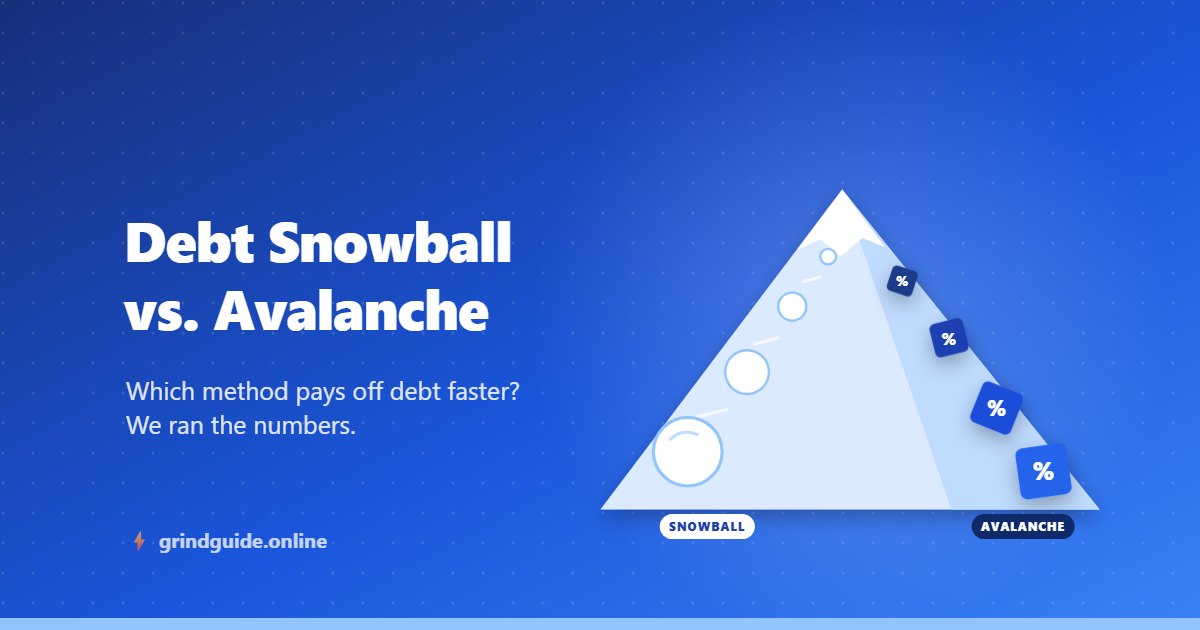
The debt snowball, popularised by radio host Dave Ramsey, ignores interest rates completely when deciding the order. You list your debts from the smallest balance to the largest, pay the minimum on everything, and throw every extra dollar at the smallest balance.
When that smallest debt is gone, you take everything you were paying on it (its old minimum plus your extra money) and roll it onto the next-smallest debt. Each payoff frees up more cash for the next one, so your payment grows like a snowball rolling downhill.
- List every debt from smallest balance to largest.
- Pay the minimum on every debt, every month.
- Send all extra money to the smallest balance.
- When it is paid off, roll its full payment into the next-smallest debt.
- Repeat until everything is gone.
The appeal is psychological. Small balances disappear quickly, so within a few months you can have one or two accounts closed out. For people who have tried to get out of debt before and lost steam, those early wins are often what keeps the plan alive.
2. How the Debt Avalanche Works
The debt avalanche uses the same rollover structure but a different order. You list debts from the highest interest rate to the lowest, and all extra money goes to the most expensive debt first, regardless of balance.
Because every extra dollar is pointed at the debt that is costing you the most, the avalanche minimises total interest paid. It is the answer a spreadsheet will give you every time. With the average credit card that charges interest now sitting at around 22 percent APR, according to Federal Reserve data, targeting the expensive debt first is a powerful idea.
The catch is that your highest-rate debt might also be one of your largest balances. If so, you can go many months making big payments without closing a single account, and that is exactly the point where many people give up.
3. We Ran the Numbers: A $25,550 Example
Here is a realistic mix of consumer debt. The minimum payments add up to $695 a month, and the household has found an extra $305, so a total of $1,000 a month goes toward debt.
| Debt | Balance | APR | Minimum payment |
|---|---|---|---|
| Medical payment plan | $850 | 0% | $50 |
| Store credit card | $2,100 | 29.99% | $65 |
| Personal loan | $3,200 | 12.5% | $105 |
| Credit card | $7,400 | 23.99% | $185 |
| Car loan | $12,000 | 7.5% | $290 |
| Total | $25,550 | $695 |
We simulated each month: interest added at each debt's APR, minimums paid on everything, and the extra money (plus any freed-up minimums) sent to the target debt. Here is how the three approaches compare:
| Approach | Debt-free in | Total interest paid | First debt cleared |
|---|---|---|---|
| Minimum payments only ($695/month) | 82 months (6 yrs 10 mo) | $12,463 | Month 17 |
| Debt snowball ($1,000/month) | 31 months | $4,856 | Month 3 |
| Debt avalanche ($1,000/month) | 30 months | $4,387 | Month 7 |
Simulation assumes fixed minimum payments and monthly compounding. Real credit card minimums shrink as the balance falls, which makes the minimum-only scenario even slower in practice.
And here is the order in which each method clears the debts:
| Debt | Snowball: paid off in | Avalanche: paid off in |
|---|---|---|
| Medical payment plan | Month 3 | Month 17 |
| Store credit card | Month 8 | Month 7 |
| Personal loan | Month 13 | Month 24 |
| Credit card | Month 24 | Month 21 |
| Car loan | Month 31 | Month 30 |
What the numbers tell us
The avalanche won, but narrowly. It saved $469 in interest and finished one month sooner. That is real money, but it works out to about $16 a month over the life of the plan.
The snowball felt very different. By month 13, the snowball had closed three accounts. The avalanche had closed one. For someone who is stressed and staring at five separate bills, going from five to two creditors in about a year is a big deal.
The real winner was the extra $305. Compared with paying only the minimums, either method cut the timeline from almost seven years to about two and a half, and saved between $7,600 and $8,100 in interest. Whichever method you choose, finding extra money to throw at your debt is what actually changes the outcome.
4. Why the "Worse" Method Often Wins
If the avalanche is mathematically better, why do so many financial coaches recommend the snowball? Because a plan only saves you money if you follow it, and research suggests that motivation, not maths, is usually the bottleneck.
Researchers David Gal and Blakeley McShane at Northwestern University's Kellogg School of Management analysed data from thousands of people in a debt settlement program. Published in the Journal of Marketing Research in 2012, their study found that closing out individual debt accounts, regardless of how large those balances were, predicted whether people went on to eliminate their debt entirely. Small victories seemed to keep people going.
A later study by Keri Kettle, Remi Trudel, and colleagues, published in 2016 and summarised in Harvard Business Review, found something similar from a different angle. People who concentrated their repayments on one account at a time felt more progress and were more motivated than people who spread extra money across several debts at once.
None of this proves the snowball is better for everyone. It shows that a feeling of progress has a measurable effect on whether people stick with debt repayment. If the avalanche would have you grinding for nine months before a single account closes, you need to be honest about whether you will still be on plan in month eight.
5. Which One Should You Choose?
Use this quick checklist.
Choose the debt avalanche if:
- You are disciplined with money and motivated by saving the most.
- Your highest-rate debt is also a small or medium balance, so you will see a payoff reasonably soon anyway.
- There is a big gap between your rates, for example a 29% store card next to a 6% car loan.
- You track your progress in a spreadsheet or app and enjoy watching the total interest number fall.
Choose the debt snowball if:
- You have tried to pay off debt before and stalled.
- You have several small balances that you could wipe out within a few months.
- Your interest rates are fairly similar, so the cost difference is small.
- Juggling many due dates is stressing you out and you want fewer bills quickly.
A simple rule of thumb
Run both orders through a free debt payoff calculator. If the avalanche saves less than a few hundred dollars, choose whichever order you are most likely to stick with. If it saves thousands, the avalanche is usually worth the patience.
6. The Hybrid Approach: Best of Both
You do not have to pick a pure version. Many people get the best results from a hybrid:
- Start with a quick win, then switch. Knock out one or two tiny balances you can clear in the first couple of months, then switch to the avalanche order for the rest.
- Avalanche, with a tie-breaker. Order by interest rate, but when two rates are within a few percentage points, target the smaller balance first.
- Ignore 0% debts until the end. In our example, the 0% medical payment plan was the first thing the snowball paid off. A 0% debt costs you nothing to carry, so paying it early is the most expensive way to get a win. If you want an early victory, pick a small debt that is actually charging interest.
7. Step-by-Step: Start Your Plan This Week
Step 1: List every debt
Write down every balance, interest rate, minimum payment, and due date. Log in to each account rather than guessing. Leave the mortgage out; it is usually a long, low-rate debt that would stall either method for years.
Step 2: Build a starter emergency fund
Before you go all-in on debt, set aside a small buffer of around $1,000, or one month of essential expenses if you can manage it. Without it, the next car repair goes straight back on a credit card and erases your progress. Our guide to building an emergency fund walks through how to do it quickly.
Step 3: Find your extra payment
This is the step that changes the outcome. A budget like the 50/30/20 rule makes it obvious where money is leaking. Cancelling unused subscriptions, cutting back on takeout, and selling things you no longer use can often free up a few hundred dollars a month. If impulse buys are the problem, our breakdown of the psychology of spending has practical fixes.
Step 4: Pick your order and write it down
Choose snowball, avalanche, or hybrid, and list your debts in that order. Put the list somewhere you will see it every week.
Step 5: Automate the minimums
Set up autopay for the minimum on every debt so you never pay a late fee or damage your credit score. Then make your extra payment to the target debt manually each payday. Doing it by hand keeps you engaged with the plan.
Step 6: Roll payments forward
When a debt hits zero, do not let its payment drift back into everyday spending. Immediately add the full amount to the next debt on your list. This rollover is what makes both methods work.
Step 7: Track and celebrate
Update your total once a month. A budgeting app can do this automatically. Mark each payoff with a small, cheap celebration. Progress you can see is fuel for the next stretch.
8. Ways to Speed Up Either Method
Ask for a lower interest rate. If you have a decent payment history, call your credit card issuer and ask for a lower APR. It does not always work, but it costs nothing and takes a few minutes.
Consider a balance transfer card. Many cards offer 0% interest on transferred balances for an introductory period, often 12 to 21 months, usually for a transfer fee of 3% to 5%. This can save a lot if you can pay off the balance before the promotion ends. Do the maths on the fee, and do not use the freed-up card for new spending.
Look at a consolidation loan carefully. A personal loan at a lower rate can replace several high-rate cards with a single fixed payment. It only helps if the new rate is meaningfully lower, the fees are small, and you do not run the cards back up afterwards.
Use windfalls. Tax refunds, bonuses, and cash gifts can knock months off your timeline if they go straight to the target debt.
Earn a little more. Even $200 to $300 a month from a side hustle can shorten a multi-year plan dramatically.
Get free help if you are overwhelmed. Nonprofit credit counselling agencies, such as members of the National Foundation for Credit Counseling (NFCC) in the US, can review your situation and may set up a debt management plan with lower interest rates. Be wary of for-profit "debt relief" companies that charge large upfront fees.
9. Common Mistakes to Avoid
- Adding new debt while paying off old debt. If the cards are still being used, neither method can work. Remove saved card details from shopping sites and leave the cards at home.
- Skipping minimum payments to make a bigger extra payment. Late fees and penalty interest rates will cost you far more than any method saves.
- Closing old credit cards immediately. Closing a paid-off card can raise your credit utilisation ratio and shorten your credit history. Often it is better to keep it open with a zero balance.
- Draining your emergency fund to pay debt. Keep at least the starter buffer, or you will be back on the cards at the first surprise.
- Overthinking the method. Spending three months debating snowball versus avalanche costs more than either choice. Pick one this week.
Frequently Asked Questions
Is the debt snowball or debt avalanche better?
The debt avalanche always costs the least interest because it targets your highest-rate debt first. The debt snowball pays off your smallest balance first, which costs a little more but gives you quick wins that help many people stick with the plan. In our $25,550 example the avalanche saved $469 and one month. If you are confident you will stay consistent, use the avalanche. If you have tried and stalled before, the snowball is usually the better bet.
How much faster is the debt avalanche than the snowball?
Usually less than people expect. In our worked example of five debts totalling $25,550 with $1,000 a month going to repayment, the avalanche finished in 30 months and the snowball in 31 months, with a $469 difference in interest. The gap grows when your largest balance also has your highest interest rate, and shrinks when your rates are similar.
Should I build an emergency fund before paying off debt?
Build a small starter emergency fund first, typically $1,000 to one month of essential expenses. Without it, the first car repair or medical bill goes straight back on a credit card and undoes your progress. Once the starter fund is in place, put every extra dollar toward debt, then grow the emergency fund to three to six months of expenses after the high-interest debt is gone.
Should I include my mortgage in the debt snowball?
Most people leave the mortgage out. Mortgages are large, long-term, usually low-rate debts, and including one would stall either method for years. Focus the snowball or avalanche on consumer debt such as credit cards, store cards, personal loans, medical bills, and car loans, then decide separately whether extra mortgage payments make sense.
Does paying off debt improve my credit score?
Usually, yes. Paying down credit card balances lowers your credit utilisation ratio, which is one of the biggest factors in most scoring models, and a record of on-time payments builds your history. Paying off an instalment loan, such as a car loan, can cause a small temporary dip because the account closes, but that is normal and not a reason to keep the debt.
The Bottom Line
The debt avalanche is the cheapest way to pay off debt, and the debt snowball is often the most motivating. In our $25,550 example, the gap between them was $469 and one month. The gap between doing something and doing nothing was more than $7,600 and four years.
So pick the method that suits how you actually behave with money, not how you wish you behaved. Build a small emergency buffer, find an extra payment, automate the minimums, and roll every freed-up dollar into the next debt. Once you are debt-free, that same monthly payment becomes the engine for building wealth. Our guide on how to start investing with just $100 is a good next step.
Disclaimer: This article is for informational purposes only and is not financial advice. Interest rates, fees, and card offers change frequently. Consider speaking with a qualified financial professional or a nonprofit credit counsellor about your specific situation.