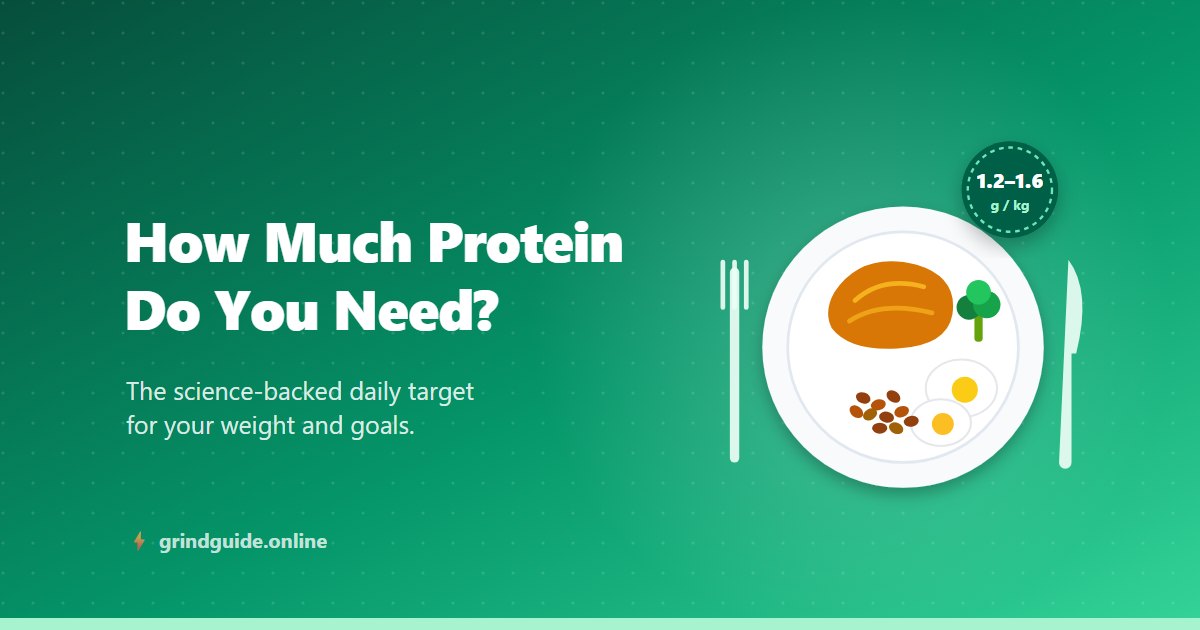
Protein has gone from a gym-bro obsession to official public health advice. In January 2026, the new Dietary Guidelines for Americans raised the recommended protein target to 1.2 to 1.6 grams per kilogram of body weight per day, well above the long-standing 0.8 g/kg figure most people have heard of. Suddenly everyone from nutritionists to food companies is talking about it, and the advice online ranges from sensible to wildly excessive.
So how much protein do you actually need? The honest answer is that it depends on your body weight, your age, and what you are trying to achieve. This guide pulls together the official recommendations and the best available research, then turns them into simple numbers you can use today, with charts, food lists, and a sample day of eating.
The quick answer
Minimum (RDA): 0.8 g per kg of body weight a day.
General health (new 2026 guideline): 1.2–1.6 g/kg.
Building muscle or losing fat: about 1.6–2.2 g/kg.
Adults over 65: at least 1.0–1.2 g/kg, more if active.
To convert to pounds, 1.6 g/kg is about 0.73 g per pound.
1. The RDA Is a Minimum, Not a Target
The Recommended Dietary Allowance (RDA) for protein is 0.8 grams per kilogram of body weight per day for healthy adults. For a 70 kg (154 lb) person, that is 56 grams.
The RDA is widely misunderstood. It was set as the amount that meets the basic needs of nearly all healthy adults, meaning enough to prevent deficiency. It was never intended to be the ideal amount for building muscle, losing fat while keeping muscle, recovering from training, or ageing well. Think of it as a floor, not a goal.
2. What Changed in 2026: The New Dietary Guidelines
The 2025–2030 Dietary Guidelines for Americans, released by the US Department of Health and Human Services and the Department of Agriculture in January 2026, set a daily protein goal of 1.2 to 1.6 grams per kilogram of body weight, adjusted for individual calorie needs. That is 50 to 100 percent more than the old minimum.
The RDA itself has not changed. It is still 0.8 g/kg. What has changed is the official target that most adults are encouraged to aim for. The guidelines pair the higher protein goal with a stronger push to limit added sugar and highly processed foods, so the intention is more protein from whole foods, not more protein bars.
Not every expert agrees with the emphasis. Some nutrition researchers, including the team behind Harvard's Nutrition Source, have praised the guidelines' tougher stance on added sugar while warning against protein hype. Most agree, though, that the range is reasonable for active adults and older people, two groups for whom 0.8 g/kg was often too low.
3. Protein Targets by Goal
| Your situation | Daily target (g per kg) | Where it comes from |
|---|---|---|
| Minimum for healthy adults | 0.8 | RDA |
| General health, moderately active | 1.2–1.6 | 2025–2030 Dietary Guidelines |
| Regular exercise or sport | 1.4–2.0 | International Society of Sports Nutrition |
| Building muscle with strength training | 1.6 (up to 2.2) | Morton et al., 2018 meta-analysis |
| Losing fat while keeping muscle | 1.6–2.2 | Sports nutrition research |
| Adults 65+ | 1.0–1.2 (1.2+ if active, 1.2–1.5 if unwell) | PROT-AGE expert group |
| Pregnancy | 1.1 (RDA) | RDA; ask your midwife or doctor |
Building muscle
The most cited research on this question is a 2018 meta-analysis led by Robert Morton and published in the British Journal of Sports Medicine. It pooled 49 randomised controlled trials with 1,863 participants who did resistance training. Gains in lean mass levelled off at a total protein intake of about 1.62 g/kg per day, with an upper confidence limit of about 2.2 g/kg.
In practical terms, 1.6 g/kg covers most people, and 2.2 g/kg is a sensible ceiling if you want to be sure you are not leaving gains on the table. Eating far beyond that has not been shown to build more muscle. Protein also only helps if you train: it supports the muscle-building signal from lifting, it does not replace it. Our guides to home workouts with no equipment and functional fitness are good places to start.
Losing fat
When you eat in a calorie deficit, your body is more likely to break down muscle along with fat. Higher protein intakes, usually toward the 1.6 to 2.2 g/kg range combined with strength training, help preserve lean mass. Protein is also the most filling macronutrient, so it makes a calorie deficit easier to stick to. If you use intermittent fasting, fitting enough protein into a shorter eating window takes some planning.
Older adults
From around middle age, muscle mass declines gradually, a process called sarcopenia, and older muscles respond less strongly to the same amount of protein. An international expert group known as PROT-AGE recommended that healthy adults over 65 eat 1.0 to 1.2 g/kg per day, at least 1.2 g/kg for those who exercise regularly, and 1.2 to 1.5 g/kg for those with acute or chronic illness. Combined with strength training, this is one of the most effective ways to stay strong and independent for longer.
4. Your Daily Protein by Body Weight
Find your weight in the left column, then read across to your target. If you carry a lot of excess body fat, use your goal weight or a healthy weight for your height instead of your current weight, otherwise the numbers will be higher than you need.
| Body weight | 0.8 g/kg (minimum) | 1.2 g/kg | 1.6 g/kg | 2.0 g/kg |
|---|---|---|---|---|
| 50 kg (110 lb) | 40 g | 60 g | 80 g | 100 g |
| 60 kg (132 lb) | 48 g | 72 g | 96 g | 120 g |
| 70 kg (154 lb) | 56 g | 84 g | 112 g | 140 g |
| 80 kg (176 lb) | 64 g | 96 g | 128 g | 160 g |
| 90 kg (198 lb) | 72 g | 108 g | 144 g | 180 g |
| 100 kg (220 lb) | 80 g | 120 g | 160 g | 200 g |
Grams of protein per day. To calculate your own number, multiply your weight in kilograms by your target, or your weight in pounds by 0.36 (minimum), 0.55, 0.73, or 0.91.
5. How to Spread Protein Across the Day
Your total daily intake matters most, but how you spread it out helps too. A 2018 review by Brad Schoenfeld and Alan Aragon in the Journal of the International Society of Sports Nutrition suggested about 0.4 g/kg per meal across at least four meals as a practical way to maximise muscle building. For most people that means roughly 25 to 40 grams per meal.
The common pattern is to eat very little protein at breakfast, a bit at lunch, and most of it at dinner. Simply moving 20 to 30 grams into breakfast, with eggs, Greek yogurt, or cottage cheese, is one of the easiest upgrades you can make. It is also a natural fit with a morning routine built for energy.
Myth: "You can only absorb 30 grams at once"
This one refuses to die. A 2023 study led by Jorn Trommelen and published in Cell Reports Medicine found that a 100-gram protein meal after exercise produced a larger and longer-lasting muscle-building response than a 25-gram meal. You do not waste protein by eating a big portion. Spreading it out is still convenient and helps with fullness, but there is no hard per-meal limit.
6. The Best Protein Sources (and How Much They Contain)
These are typical values. Exact amounts vary by brand and preparation, so check labels where you can.
| Food | Serving | Protein (approx.) |
|---|---|---|
| Chicken breast, cooked | 100 g (3.5 oz) | 31 g |
| Lean beef, cooked | 100 g (3.5 oz) | 26 g |
| Tuna, canned in water, drained | 100 g (3.5 oz) | 25 g |
| Salmon, cooked | 100 g (3.5 oz) | 22–25 g |
| Cottage cheese | 1 cup (about 225 g) | 24–28 g |
| Whey protein powder | 1 scoop (about 30 g) | 20–25 g |
| Tempeh | 100 g | 19–20 g |
| Lentils, cooked | 1 cup (about 200 g) | 18 g |
| Edamame, shelled | 1 cup (about 155 g) | 17–18 g |
| Greek yogurt, plain non-fat | 170 g (6 oz) | 17 g |
| Firm tofu | 100 g | 12–17 g |
| Chickpeas, cooked | 1 cup (about 165 g) | 14–15 g |
| Milk | 1 cup (240 ml) | 8 g |
| Peanut butter | 2 tablespoons | 7–8 g |
| Egg | 1 large | 6 g |
Protein-rich foods are also some of the best candidates for batch cooking. If you struggle to eat enough during a busy week, our meal prep guide for beginners makes it much easier to have high-protein meals ready to go.
7. Getting Enough Protein on a Plant-Based Diet
You can absolutely meet your protein needs without meat, but it takes a bit more planning. Plant proteins are often slightly less digestible and lower in certain essential amino acids, especially leucine, which plays a key role in triggering muscle growth.
- Eat a variety of sources. Combining legumes, grains, nuts, and seeds over the day gives you a complete amino acid profile. They do not need to be in the same meal.
- Lean on soy. Tofu, tempeh, edamame, and soy milk are complete proteins and among the most protein-dense plant foods.
- Aim slightly higher. Many dietitians suggest vegans aim toward the upper end of their target range to make up for lower digestibility.
- Consider a plant protein powder. Pea and soy blends are a convenient way to top up if whole foods are not getting you there.
8. What 120 Grams Looks Like: A Sample Day
Here is a realistic day for a 75 kg (165 lb) person aiming for about 1.6 g/kg, or 120 grams.
| Meal | What to eat | Protein |
|---|---|---|
| Breakfast | 200 g Greek yogurt with berries and a handful of almonds | ~25 g |
| Lunch | Chicken breast (120 g) wrap with salad | ~42 g |
| Snack | 2 hard-boiled eggs and a glass of milk | ~20 g |
| Dinner | Salmon fillet (120 g) with lentils and vegetables | ~38 g |
| Total | ~125 g |
No supplements, no shakes, and nothing unusual. For most people the biggest change is adding a serious protein source at breakfast and lunch rather than relying on dinner.
9. Is Too Much Protein Harmful?
For healthy people, higher protein intakes are generally safe. A 2018 meta-analysis in the Journal of Nutrition found no evidence that higher protein diets harm kidney function in people with healthy kidneys.
There are some important caveats, though:
- Kidney disease is different. If you have chronic kidney disease, you may be advised to limit protein. Follow your doctor's or dietitian's advice, not general targets.
- Watch what comes with the protein. Getting most of your protein from processed meats such as bacon, sausages, and deli meats is linked to higher risks of heart disease and some cancers. Prioritise fish, poultry, eggs, dairy, legumes, and soy.
- Do not crowd out fibre. A very high-protein diet can push out fruit, vegetables, and whole grains. Protein should be added to a balanced plate, not replace it.
- Drink enough water. Higher protein intakes increase the body's water needs slightly.
10. Do You Need Protein Powder?
No, but it can be useful. Protein powder is simply a convenient food. If you are hitting your target with meals, you do not need it. If you are busy, travel often, or struggle with appetite, a shake can easily add 20 to 25 grams.
Supplements are lightly regulated, so choose products tested by an independent third party, such as those carrying the NSF Certified for Sport or Informed Sport marks. These programs test for contaminants and banned substances. For more on which supplements are actually worth your money, see our science-backed supplements guide.
Frequently Asked Questions
How much protein do I need per day?
The minimum to avoid deficiency (the RDA) is 0.8 grams per kilogram of body weight per day. The 2025–2030 Dietary Guidelines for Americans set a higher daily goal of 1.2 to 1.6 grams per kilogram for most adults. If you lift weights to build muscle or are losing weight and want to keep your muscle, research supports about 1.6 to 2.2 grams per kilogram. For a 70 kg (154 lb) adult, that means roughly 84 to 112 grams a day for general health.
How much protein do I need to build muscle?
A widely cited 2018 meta-analysis of 49 resistance training studies found that gains in muscle mass plateaued at about 1.6 grams of protein per kilogram of body weight per day, with an upper confidence limit of about 2.2 g/kg. Aiming for 1.6 g/kg covers most people, and going up to 2.2 g/kg is a reasonable safety margin for those who want to be sure.
Is eating too much protein bad for your kidneys?
In people with healthy kidneys, research has not shown that higher protein intakes cause kidney damage. People with chronic kidney disease are different and are often advised to limit protein, so anyone with a kidney condition should follow their doctor's or dietitian's advice rather than general targets.
Can your body only absorb 30 grams of protein at once?
No. This is a common myth. A 2023 study found that a 100-gram protein meal produced a larger and longer-lasting muscle-building response than a 25-gram meal. Spreading protein across three or four meals is still a sensible way to hit your daily target, but your total daily intake matters far more than any single meal.
Should I use my current weight or goal weight?
If you are at or near a healthy weight, use your current weight. If you carry a lot of excess body fat, use your goal weight or a healthy weight for your height. Protein needs are driven mostly by lean mass, so calculating from a much higher body weight overestimates what you need.
The Bottom Line
The old 0.8 g/kg figure was always a minimum, and the new 2026 Dietary Guidelines now recommend 1.2 to 1.6 g/kg for most adults. If you strength train or are trying to lose fat, aim for around 1.6 g/kg, with 2.2 g/kg as a sensible upper limit. Older adults benefit from at least 1.0 to 1.2 g/kg, and more if they are active.
Work out your number from the table above, spread it across three or four meals, and get most of it from whole foods like fish, poultry, eggs, dairy, legumes, and soy. Pair it with regular strength training and good sleep (our sleep hygiene guide covers the basics), and you have the foundations of a strong, healthy body for decades to come.
Medical disclaimer: This article is for general information only and is not medical or dietary advice. If you are pregnant, have kidney disease or another medical condition, or are under medical supervision, speak to your doctor or a registered dietitian before changing your diet.